
Published cartoon ·
Are there any blockers?
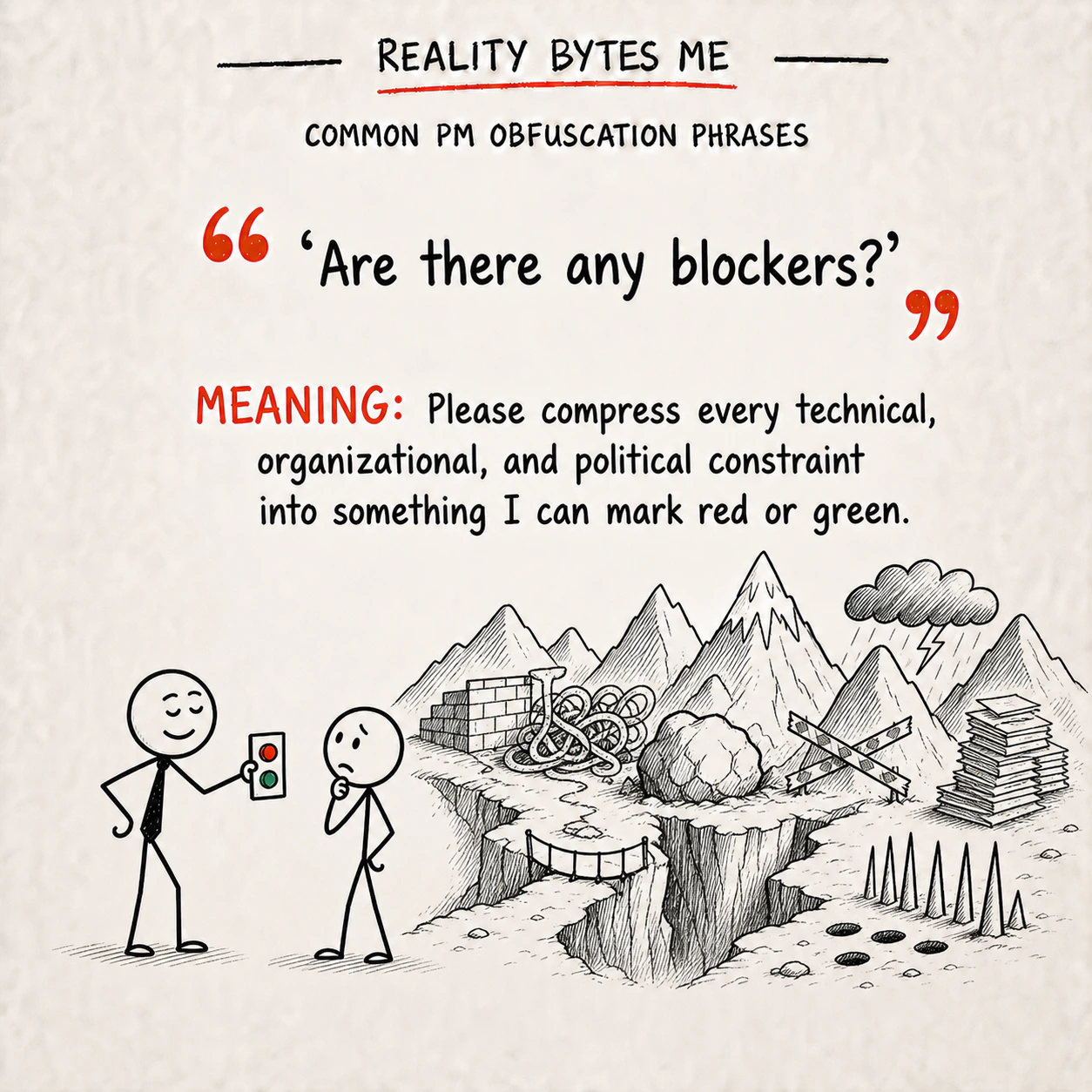
An obstacle course, summarised as a traffic light.
Why this one bites
The employee faces mountains, a chasm, a storm, a wall, tangled rope and paperwork. The manager has a red-or-green indicator. The question asks a complex situation to fit a reporting format with far fewer possibilities than the situation itself.
The cartoon is about what compression removes. A status colour may attract attention, but it cannot explain which decision, dependency or resource would make progress possible. The entire landscape becomes background to a box the manager can tick.
Accessible summary
- A manager holds a two-colour signal beside a worried colleague. Behind them is a landscape filled with barriers, hazards and a stack of documents.
- The caption asks for technical, organisational and political constraints to be compressed into red or green.
Reading notes
The question is useful only if an honest answer changes what happens next. A team member may be waiting for access, a decision, another team's capacity or a contradiction in the plan to be resolved. Naming that obstacle creates an opportunity for someone with the right authority to intervene. If the response is simply to ask the same employee to work around it, the question has collected a problem without accepting any responsibility for removing it.
There is a social calculation behind every status answer. People learn whether reporting difficulty brings assistance, blame or a longer reporting requirement. A room that repeatedly punishes bad news can become remarkably free of declared blockers while the work remains thoroughly blocked. Silence then looks like confidence until the missed date makes the hidden constraint impossible to ignore.
The constructive follow-up is specific: what is needed, who controls it and when will that person act? Some obstacles can be removed; others require changing the plan. Both are better than classifying the problem as an attitude. The cartoon sits in that gap between requesting candor and making candor useful. A checklist can prove that the question was asked. It cannot prove that anyone was willing to hear the answer.