
Published cartoon ·
Principal Technical Dictator
A promotion in everything except title, pay and authority.
Why this one bites
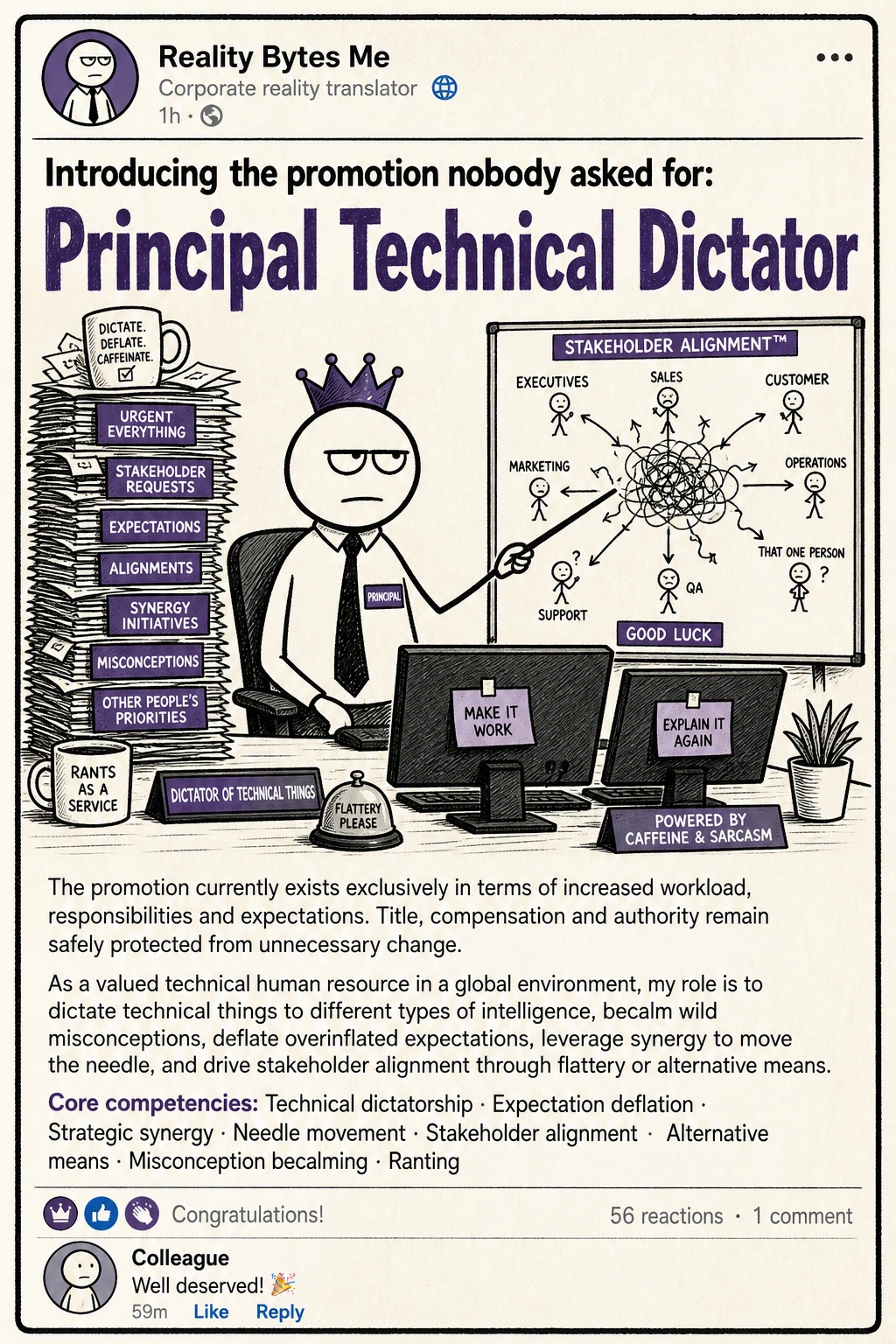
The announcement borrows the language of career progression while describing a familiar bargain: more responsibility with no corresponding change in status or power. The crown promises command; the piles of requests and tangled stakeholder diagram reveal what the employee has actually received.
The mock social-media congratulations complete the mismatch. Outsiders can applaud a promotion whose benefits exist mainly for the organisation. The person at the desk must make the work happen, explain it repeatedly and reconcile other people's priorities under an impressive imaginary title.
Accessible summary
- A crowned employee sits between towers of paperwork, two monitors and a tangled stakeholder-alignment diagram. Notes demand that they make it work and explain it again.
- The mock announcement says workload, responsibilities and expectations have increased while title, compensation and authority remain unchanged. A colleague responds with congratulations.
Reading notes
A real promotion normally changes some combination of remit, authority, support and reward. This fictional announcement changes the volume of expectation while allowing the organization to congratulate itself on recognizing talent. The impressive title exists mainly as a description of the problems the employee is now expected to absorb. The crown is ornamental; the workload is not.
The stakeholder diagram is the practical job description. Somebody has to reconcile incompatible requests, explain the same constraint to several audiences and accept responsibility when one of those audiences remains dissatisfied. Without permission to set priorities or refuse work, technical leadership becomes an obligation to persuade people who retain the right to ignore the answer. The organization has delegated coordination without delegating the decisions that coordination requires.
The congratulatory response adds a second audience to the joke. Public recognition can make an unequal bargain look like personal success. It becomes awkward to explain that the supposed advancement delivered no additional control, because doing so sounds ungrateful. The cartoon asks a more useful question than whether the announcement sounds impressive: what can this person now decide that they could not decide before? If the answer is nothing, the promotion may belong to the organization's expectations rather than the employee's career.