Published cartoon ·
Senior Assumption Removal Specialist
One question away from discovering what the plan rests on.
Why this one bites
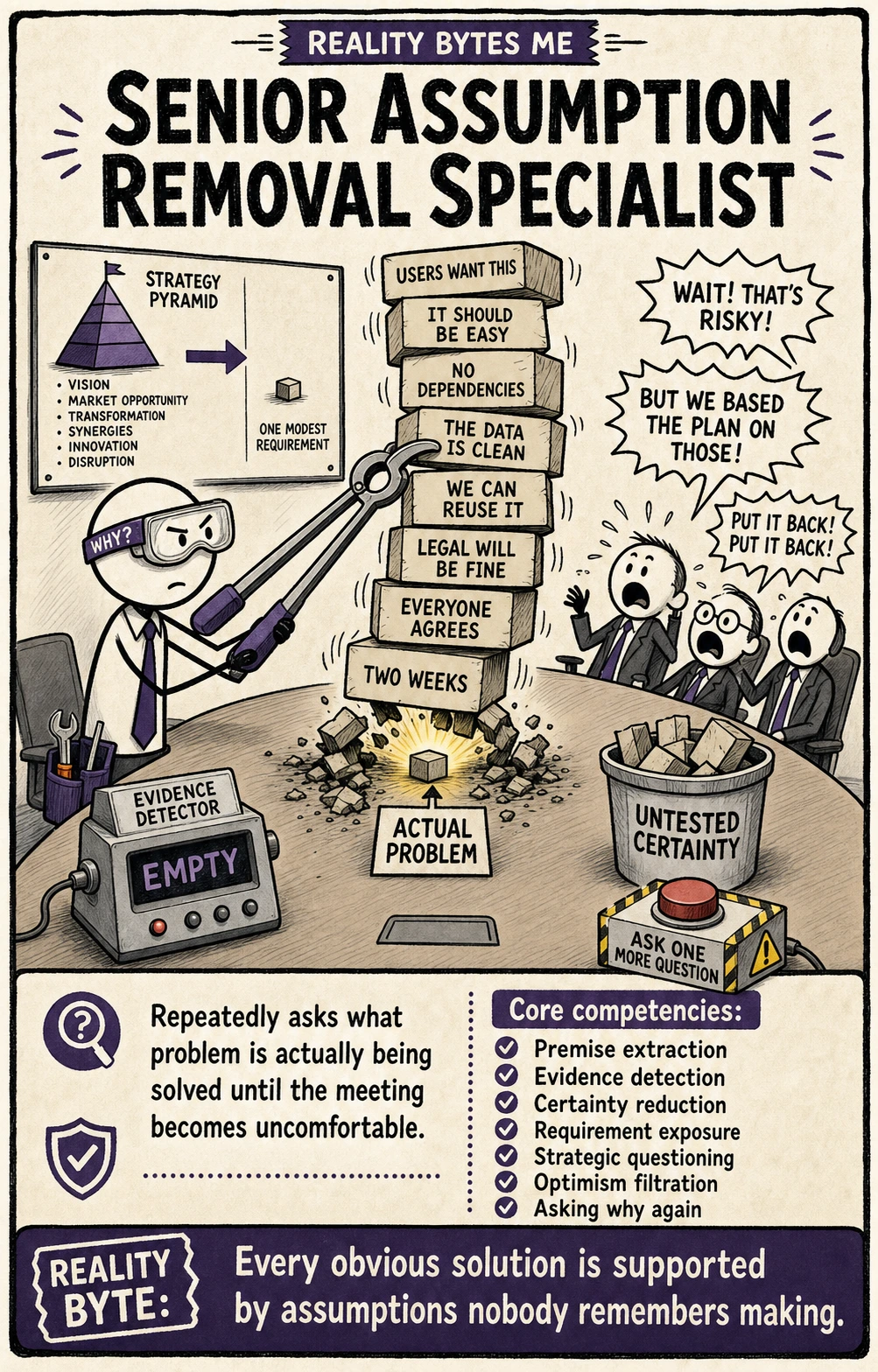
The specialist removes a block from a tower of untested claims while the meeting protests that the plan depends on those claims. The actual problem is a small object beneath the structure; confidence has made everything above it much larger.
The comic reverses the accusation of risk. Asking for evidence appears dangerous because it threatens the plan's stability, even though the instability was already there. The specialist's unpopular contribution is to expose the assumptions before the organisation has to discover them through failure.
Accessible summary
- An employee wearing protective glasses pulls at a tower of blocks labelled with claims about users, effort, dependencies, data, reuse, legal approval, agreement and a two-week schedule.
- An evidence detector reads Empty. Colleagues demand the block be put back, while discarded pieces fill a bin labelled Untested Certainty.
Reading notes
Every plan uses assumptions. The useful distinction is between assumptions that have been named and tested, and assumptions that have quietly acquired the status of facts. The tower contains claims from different domains: users, data, legal review, dependencies and effort. Confidence in one does not validate the others. A technically feasible proposal can still fail because permission, demand or usable information never existed.
Removing a block feels destructive because the plan has already been assembled around it. That is the specialist's social problem. The investigation is treated as the cause of instability when it is actually revealing instability that was present from the beginning. The instruction to put the block back is therefore a request to restore confidence without restoring support.
A productive review identifies which assumption would be most expensive to discover late and looks for a cheap way to test it early. The answer may strengthen the plan, narrow its scope or make a different approach preferable. None of those results requires treating the questioner as an enemy. The cartoon asks why evidence is welcomed in principle but resented at the moment it can change the decision. The specialist's contribution is not to make every plan collapse; it is to prevent people from mistaking an untested stack of claims for a foundation.