
Published cartoon ·
Chief Technical Obfuscator
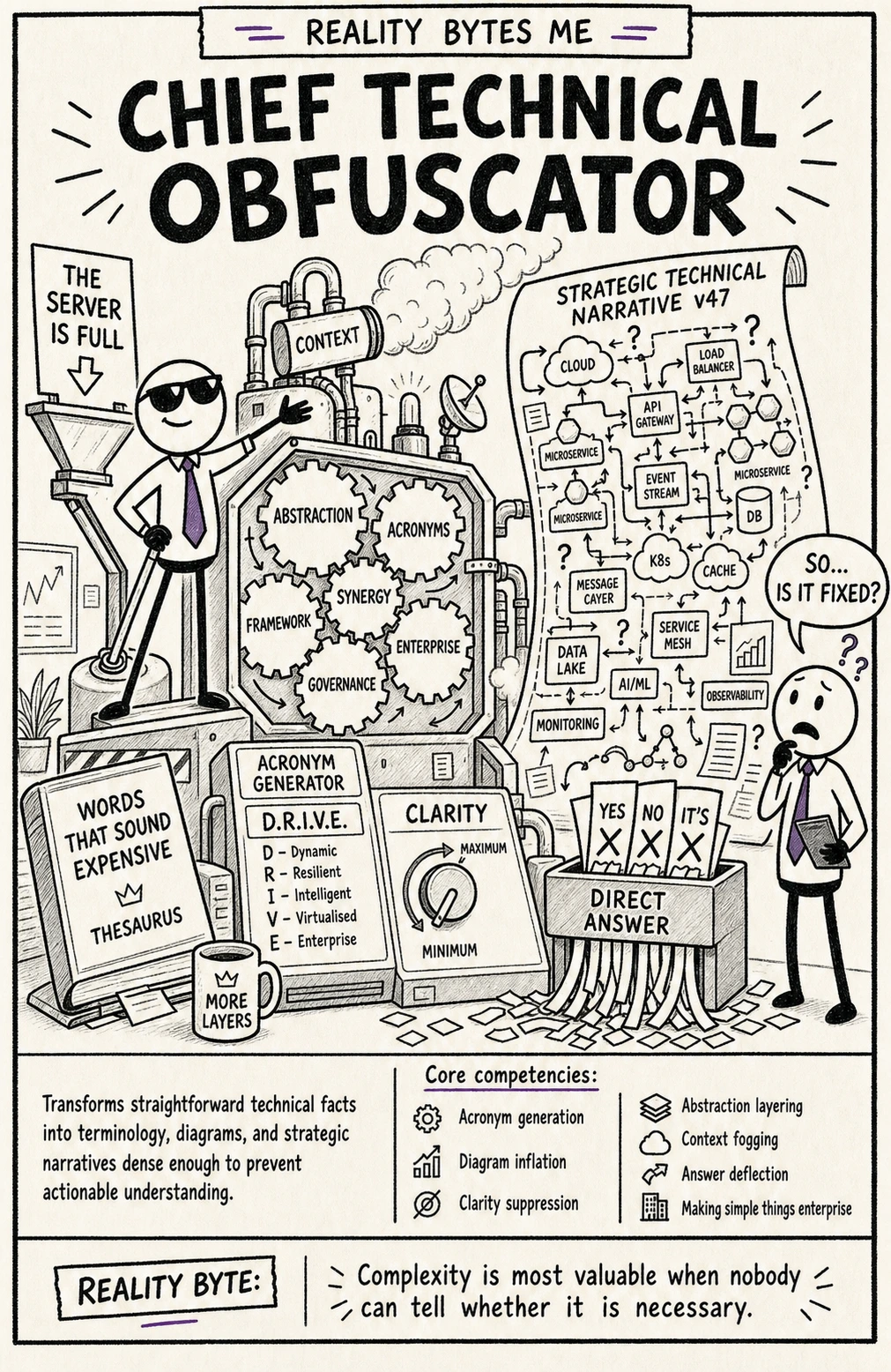
A full server becomes an enterprise narrative.
Why this one bites
A straightforward technical fact enters a machine of acronyms, abstraction and expensive-sounding words. Out comes an elaborate architecture diagram, while the person waiting for help still needs to know whether the problem is fixed.
The satire is about complexity used to prevent action rather than explain a system. The machinery consumes direct answers and produces more context, leaving the speaker impressive and the listener dependent. The unresolved question beside the diagram is the measure of how little the transformation has accomplished.
Accessible summary
- A machine receives the statement that the server is full. Its gears include abstraction, acronyms, frameworks, synergy, governance and enterprise, and it produces a strategic technical narrative.
- A direct-answer shredder consumes simple responses while a worried colleague asks whether the issue is fixed. A clarity dial and acronym generator make confusion look like a managed capability.
Reading notes
Technical vocabulary is useful when it names a distinction that ordinary language would lose. It becomes obfuscation when it increases the listener's dependence without increasing their understanding. The server being full may have a complicated cause, but the person waiting for help still needs a clear account of the immediate impact, the proposed response and when service will recover.
The architecture diagram is therefore not inherently the villain. A good diagram could show where capacity is exhausted or which dependency prevents expansion. This one earns its satirical role by replacing the answer rather than supporting it. The transformation makes a straightforward fact sound strategic while leaving the operational question exactly where it began. Complexity becomes a credential that the audience is expected to admire instead of a problem someone is expected to solve.
A useful explanation lets readers move between levels of detail. Start with the outcome and the decision, then offer the mechanism and evidence for anyone who needs them. The obfuscator reverses that route, placing enough abstraction in front of the answer that the audience may stop asking. The direct-answer shredder makes the incentive explicit: if simple statements survive, someone might notice that the impressive narrative has not yet freed any space on the server.