
Published cartoon ·
Schrödinger’s Head of Department
Authority changes state when the result arrives.
Why this one bites
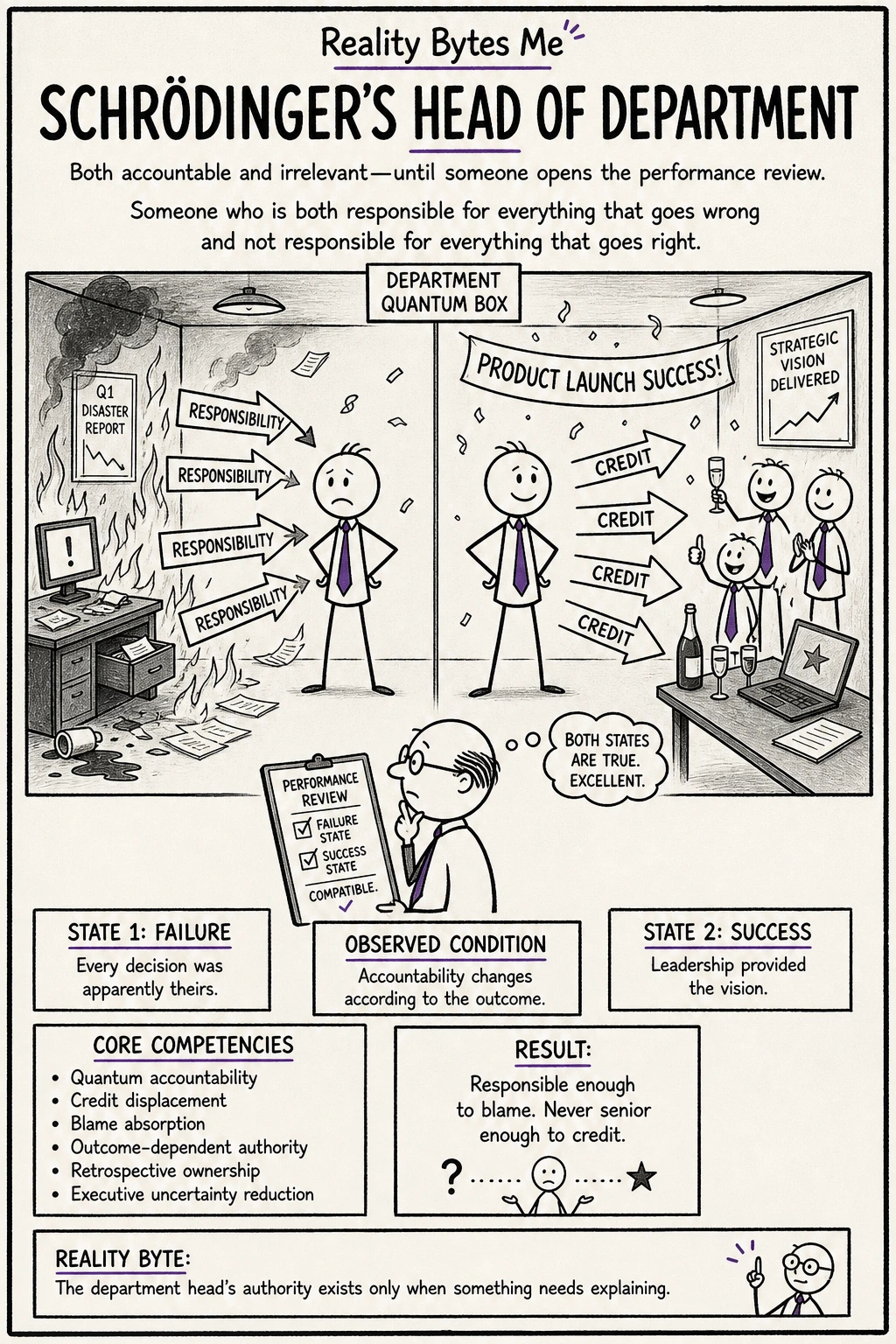
The department head occupies two outcomes at once. In the burning half of the room, responsibility points inward. In the successful half, credit points away toward celebrating leadership. The performance review finds both arrangements entirely compatible.
The quantum metaphor satirises retrospective ownership rather than physics. The person's influence over the work is defined after the result is known: extensive enough to explain failure, insufficient to claim success. The contradiction works because it benefits the people conducting the assessment.
Accessible summary
- A divided department shows fire and failure on one side, a successful launch on the other. Responsibility arrows point toward the head; credit arrows point toward the celebrating group.
- A reviewer accepts both states. The result describes someone sufficiently responsible to blame but never sufficiently senior to credit.
Reading notes
Ownership should be established before the outcome is known. A department head may control some decisions, influence others and depend on resources supplied elsewhere. Those boundaries do not logically reverse because the work succeeds. The divided room shows an evaluation system in which the boundaries move retrospectively to preserve a preferred distribution of blame and credit.
This arrangement creates a practical incentive problem. If good results are attributed upward while failures remain local, the person managing the department learns that taking responsibility carries a one-sided cost. They may become defensive, reluctant to disclose risks or preoccupied with documenting decisions that somebody else will later reinterpret. The organization can then mistake that self-protection for the employee's natural leadership style rather than a response to the review system.
A fairer account asks the same questions on both sides of the room. What decisions did the head make? What did the team contribute? Which constraints came from leadership? What would reasonably have changed the result? The answers can recognize both individual performance and shared conditions without treating either as an all-purpose excuse. The quantum joke is not about a mysterious person who is simultaneously competent and incompetent. It is about an assessment that changes the meaning of responsibility whenever doing so benefits the assessor.