
Published cartoon ·
The Ficus Manager
Always there. Never steals your ideas. Thrives on indirect light.
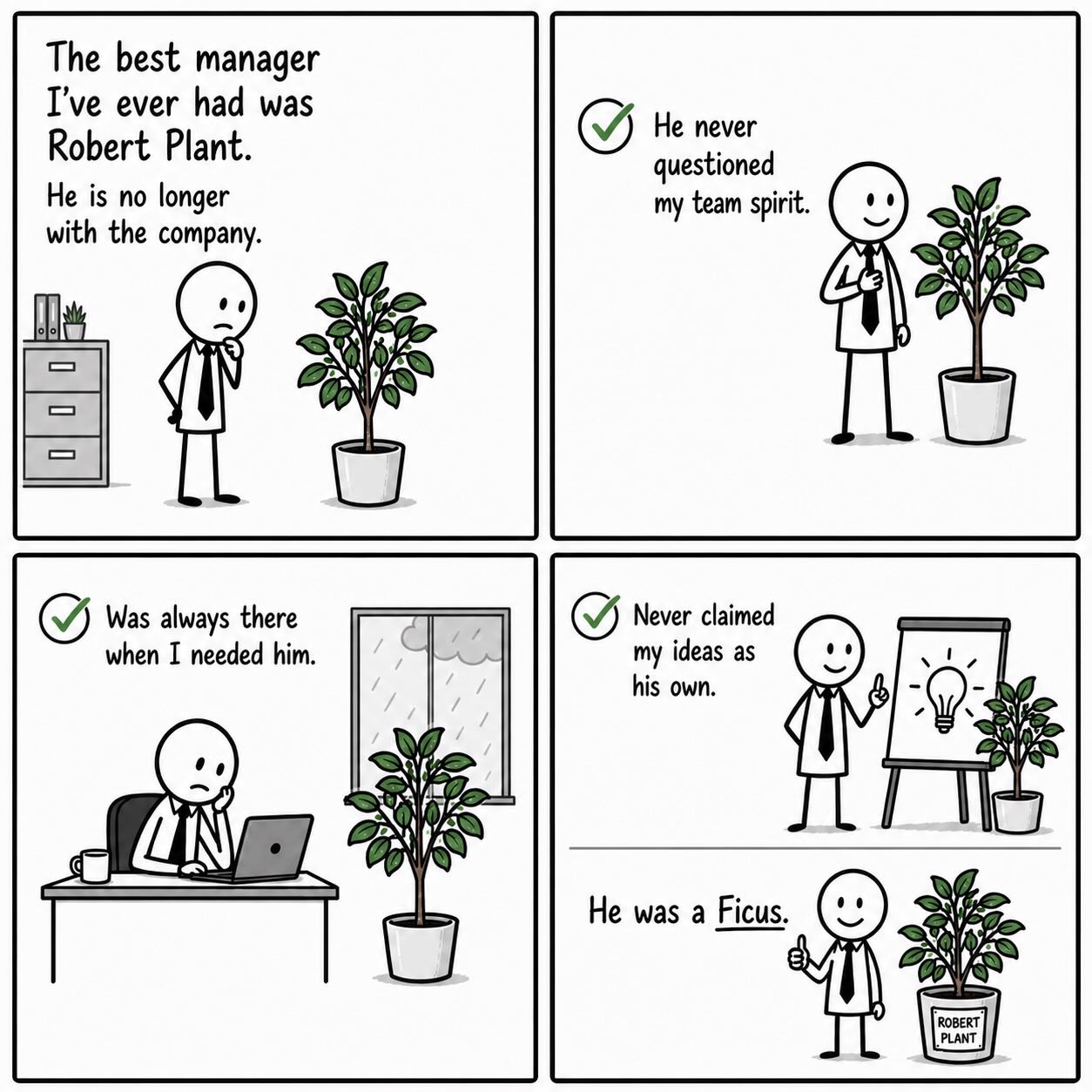
Scene and commentary
The comic begins with an employee remembering the best manager they ever had: Robert Plant, who is no longer with the company. Subsequent panels praise his dependable presence, his refusal to question the employee's team spirit and his habit of never claiming the employee's ideas. The final reveal is literal. Robert Plant was a ficus, standing in a pot labelled with his name.
The joke measures management against an unexpectedly modest baseline: a plant does not interfere, disappear into politics or appropriate credit. Those qualities should not be exceptional. They become sufficient for nostalgic praise only when the employee's experience of human managers has made the absence of harmful behavior feel like outstanding support. The ficus wins by declining to do things that a plant could never have done in the first place.
The repeated presence of the plant also gives the comparison a gentle absurdity. It is there by the desk, beside the explanation and during a difficult-looking day. The employee can project reliability onto an object that makes no promises. The humor depends on that contrast between organizational language and botanical reality: a performance review built entirely from virtues supplied by photosynthesis and immobility.
This is not an argument that good management requires doing nothing. Useful managers can resolve conflicts, protect time, develop people and obtain resources. The ficus cannot perform any of those tasks. The sharper question is why the employee is so relieved simply to avoid the opposite: needless suspicion, instability and stolen recognition. A manager who adds work while subtracting trust may struggle to outperform the office greenery.
The final label makes Robert's identity unambiguous and keeps the story fictional. It invites a reader to ask which daily managerial habits create enough value to justify the attention they consume. A plant offers no strategic vision, but it also never schedules a meeting to explain why someone else's idea should now be credited to the person standing nearest the pot.