Published cartoon ·
The Dictator
Workplace satire from RealityBytesMe.
Scene and commentary
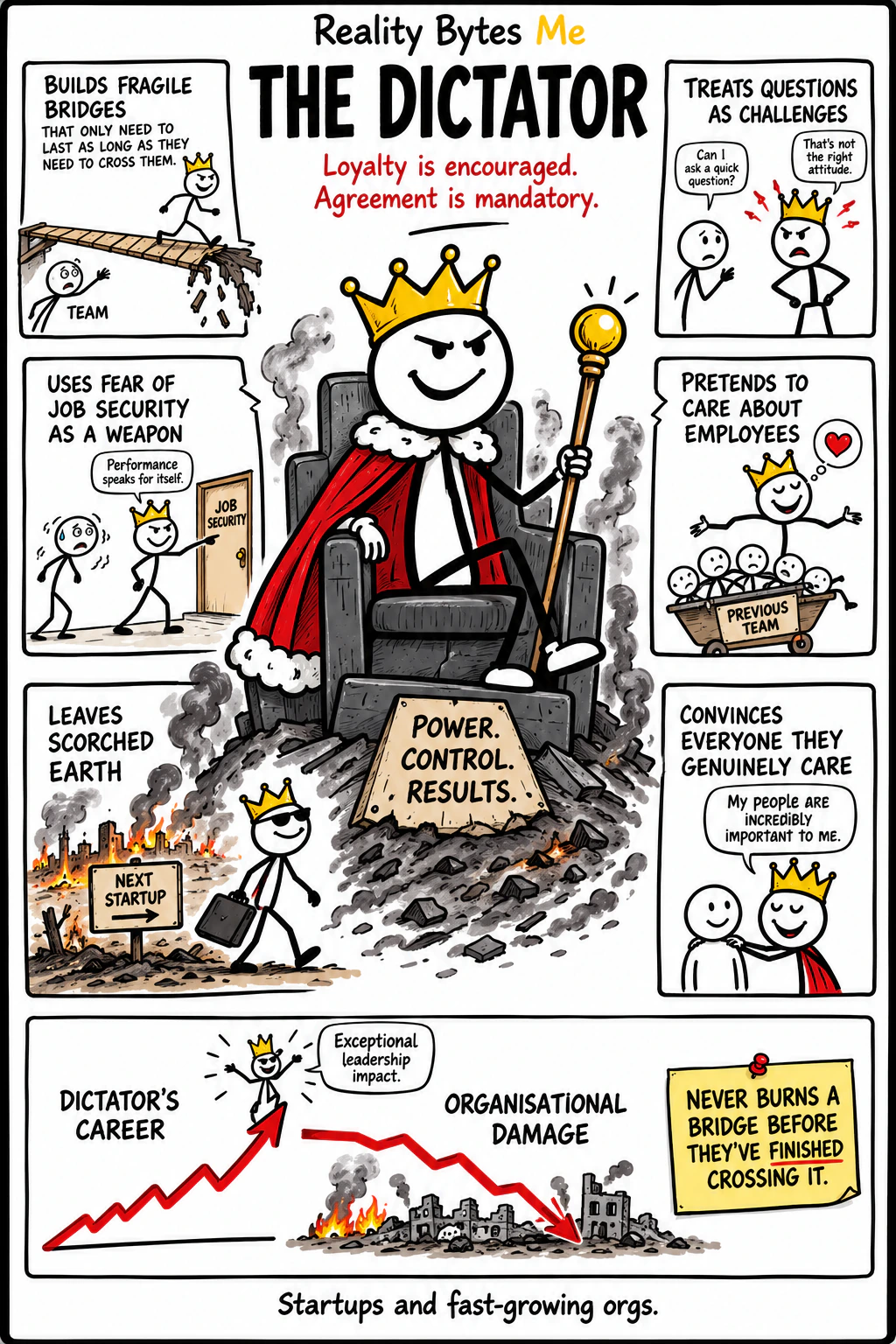
The Dictator sits on a throne surrounded by smoke and rubble, holding a sceptre beneath a crown. Around the figure, a bridge collapses after the leader crosses it, questions are treated as attitude problems and concern for employees is staged above a cart labelled previous team. Another scene sends the leader towards a new startup while the old setting burns. At the bottom, personal career progress rises while the organization left behind visibly deteriorates.
The bridge is the clearest expression of the character's time horizon. It only needs to remain usable long enough for the leader to benefit. People who must cross afterwards inherit the weakness without having chosen it. In a workplace, the equivalent might be a rushed commitment, a depleted team or an undocumented dependency that becomes somebody else's problem after the next promotion or departure.
The cartoon also contrasts the language of care with the exercise of control. A reassuring statement is easy to perform in a single conversation. Its meaning depends on whether people can raise a concern, retain reasonable autonomy and receive support when a decision becomes difficult. The frightened questioner in the upper panel supplies information that the warmer scene would otherwise conceal. Both belong to the portrait.
The career chart is not a claim that damaging management always succeeds. It is a satirical question about what an organization measures and when it measures it. If an evaluation captures only a short period of apparent results, costs passed into the future may remain outside the frame. The individual can receive credit before the wider consequences have become visible enough to be attributed.
Reading the page as a whole suggests checking durability as well as immediate output. Can the team continue functioning after the leader leaves? Are relationships, knowledge and capabilities stronger or weaker? Who bears the consequences of decisions made under pressure? The final bridge joke makes those questions concrete. A leader who reaches the far bank has demonstrated that the bridge served one journey; that alone says very little about whether it was built responsibly for everyone expected to use it.