Published cartoon ·
The Spreadsheet General
Workplace satire from RealityBytesMe.
Scene and commentary
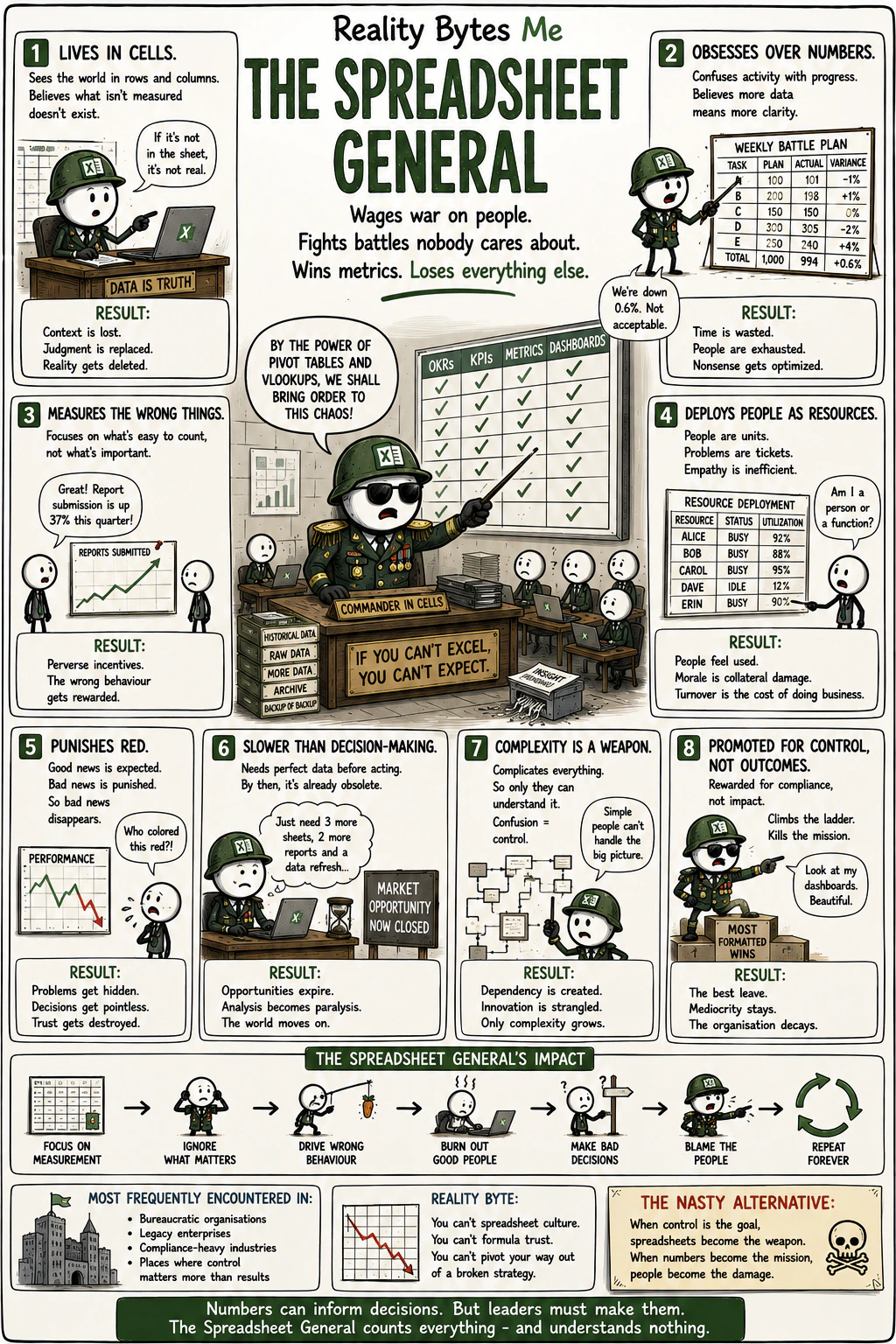
The Spreadsheet General wears a military uniform and an Excel-marked helmet, directing a room of workers beneath a board full of green checks. The surrounding scenes turn unmeasured work into unreality, treat a small numerical variance as a battle and celebrate an increase in reports submitted. People appear as utilization percentages, bad news is punished and decisions wait for still more data. A promotion finally rewards control and elaborate dashboards rather than the outcomes they were supposed to help produce.
The target is the replacement of judgement with measurement, not the existence of a spreadsheet. Rows and columns can make a complex situation easier to inspect. They become misleading when the selected measures are treated as the whole situation. A report count, for example, says something about reporting activity but little by itself about whether the reports improved any decision or service.
The red-status panel shows how a measurement system can change the information it receives. If reporting a problem brings punishment, people gain a reason to soften or delay the report. The dashboard may become greener while the work becomes less predictable. The apparent control then rests on a shrinking supply of candid evidence, precisely the opposite of what useful reporting should create.
The utilization table adds a human consequence. A person represented as a resource percentage can look interchangeable with another row even when their knowledge, obligations and recovery needs differ. Planning still requires an understanding of capacity, but a number should invite questions about that capacity rather than close them. Maximizing visible busyness can leave no room for learning, unexpected work or the coordination required to finish anything well.
A practical reading begins with the decision a metric is meant to inform. What does it include, what does it omit and what behaviour will change if people are rewarded for improving it? A smaller set of interpretable measures can be more useful than a larger reporting apparatus nobody can challenge. The General's battlefield is orderly on paper, yet the mission is disappearing behind the cells. Numbers become valuable when they help people understand the work, not when the work is reorganized solely to make the numbers look obedient.