Published cartoon ·
The Datamancer
Workplace satire from RealityBytesMe.
Scene and commentary
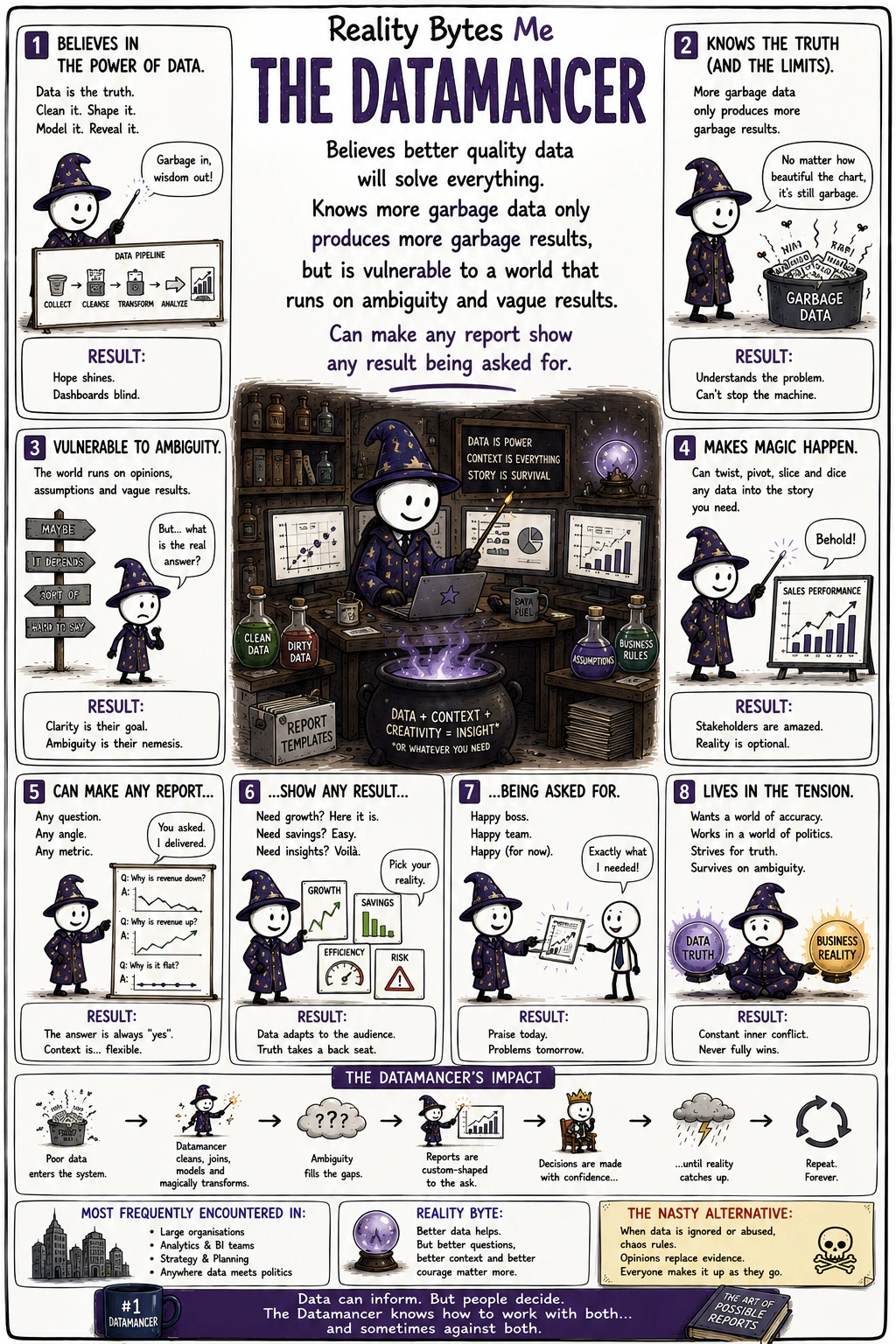
The Datamancer works in a wizard's room filled with charts, bottles and a bubbling cauldron. Ingredients include clean data, dirty data, assumptions and business rules. The surrounding panels begin with data preparation and an understanding of poor inputs, then move into ambiguity, adjustable narratives and reports shaped to the result being requested. In the final balancing act, the character holds data truth in one hand and business reality in the other.
The portrait contains a real capability as well as a risk. Cleaning, joining and interpreting data can reveal patterns that were previously obscured. The Datamancer understands that a beautiful chart cannot rescue an unsuitable input. That technical competence becomes vulnerable when the question itself is vague or when the organization has already decided what answer it wants. Better processing cannot settle an undefined purpose by itself.
The cauldron makes assumptions visible as ingredients. A report is not simply a pile of facts poured onto a screen. It includes choices about definitions, populations, time periods and comparisons. Those choices may all be reasonable, yet different choices can produce different impressions. The satire begins when that flexibility is used to satisfy an audience without making the choices legible to the people relying on the result.
The panels offering growth, savings and efficiency on demand show how a skilled analyst can be rewarded for accommodation. A pleased requester may praise a chart that confirms the preferred story more quickly than one that complicates it. The Datamancer then faces a tension between explaining uncertainty and delivering the clean conclusion that will travel easily into the next presentation. Confidence can spread farther than the qualifications attached to it.
A useful reading asks for the question before the chart and the definitions alongside the answer. Which records were included, what comparison is being made and what alternative interpretation remains plausible? Those details let another person inspect the reasoning rather than simply admire the presentation. The wizard metaphor is effective because impressive output can conceal the method that produced it. Responsible analysis makes that method less magical and more visible, preserving the distinction between a result supported by the data and a result the audience merely hoped to see.