
Published cartoon ·
The Birth of Flexible Desks
How removing everybody else's desk became an employee-experience initiative.
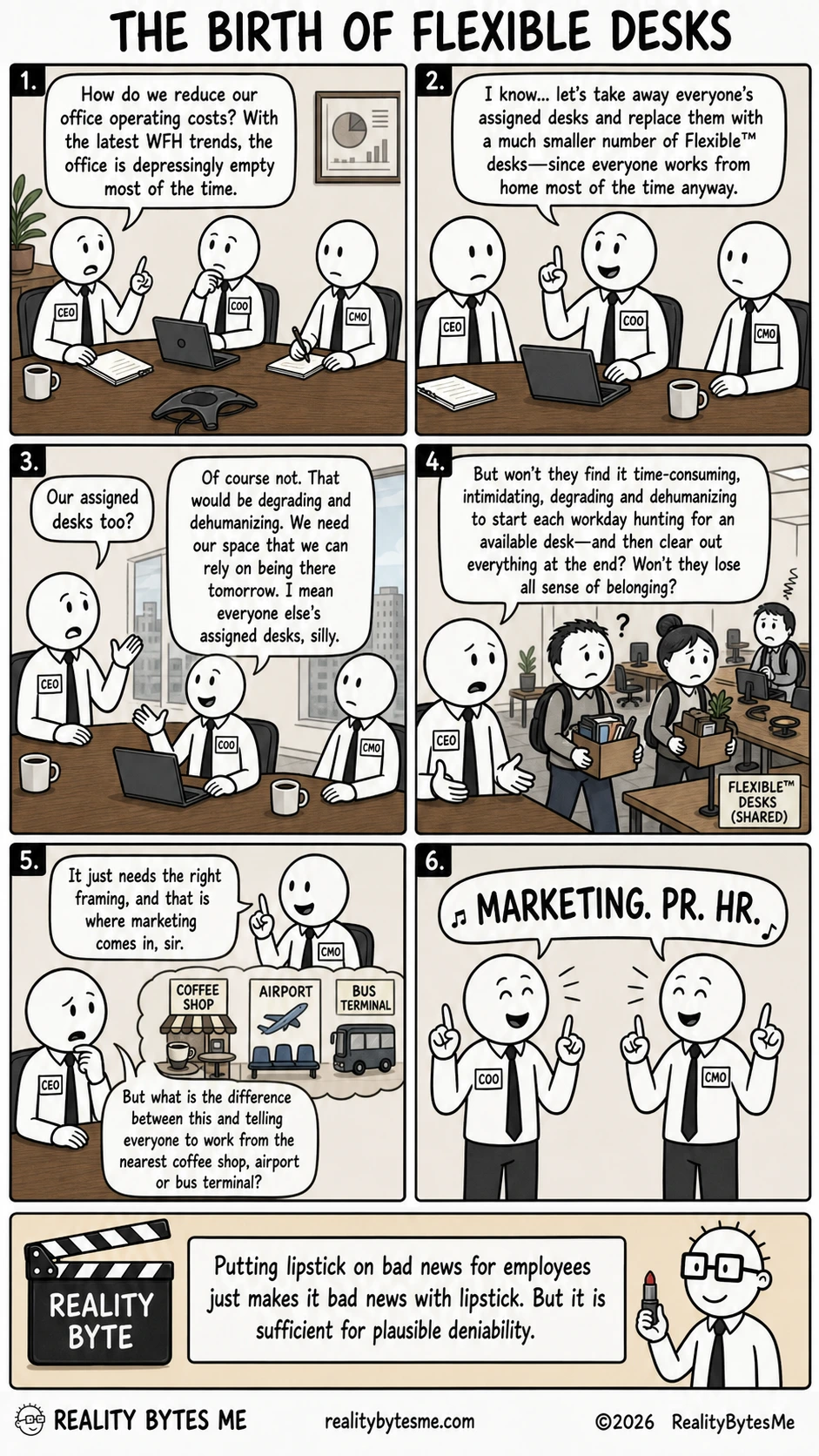
Why this one bites
Flexible desks solve a real estate problem by turning it into a daily employee problem. The saving is measurable; the time spent hunting for a workable place, clearing it again and losing a small sense of belonging is conveniently dispersed.
The joke is about framing. Once an unpopular cost reduction has been passed through Marketing, PR and HR, management can discuss the language of flexibility instead of the loss of certainty.
Transcript
- CEO: How do we reduce our office operating costs? With the latest work-from-home trends, the office is depressingly empty most of the time.
- COO: Let's take away everyone's assigned desks and replace them with a much smaller number of Flexible™ desks, since everyone works from home most of the time anyway.
- CEO: Our assigned desks too? COO: Of course not. That would be degrading and dehumanizing. I mean everyone else's assigned desks.
- CMO: It just needs the right framing, and that is where marketing comes in, sir.
- COO and CMO: Marketing. PR. HR.
- Moral: Putting lipstick on bad news for employees just makes it bad news with lipstick. But it may be sufficient for plausible deniability.
Reading notes
The executives' exemption is the revealing comparison. They immediately understand why losing an assigned desk could feel degrading when the proposal reaches their own offices. The same consequence becomes flexibility when it applies to everyone else. The comic does not need to establish that shared desks are always bad; it exposes the selective empathy used to sell this particular decision.
A practical workplace policy would consider who needs predictable equipment, accessible space, private conversations or reliable proximity to colleagues. It would also explain the capacity available on busy days. Those questions concern whether the arrangement serves the work. Rebranding the change cannot answer them. The satire sharpens when the communication departments are asked to solve a problem of acceptance before anyone has demonstrated that the people affected have a workable place to sit.